The crypto exchange space is exploding. Daily trading volumes hit record highs. More users are joining. More coins are launching, Bitcoin is setting new all time highs. And more competitors are trying to grab a piece of the market.
But here’s the truth: most new exchanges fail to grow. Not because the idea is bad. Not because the tech is weak. But because they try to scale by throwing money at every problem without a real plan.
Scaling doesn’t mean spending more. It means building smart, making the right moves at the right time, and avoiding the traps that drain your budget and slow your growth.
In this guide, we will walk through how to scale your crypto exchange business without burning through capital.
You’ll learn how to:
- Prepare your platform for high-volume growth
- Boost liquidity without overpaying market makers
- Add valuable features your users actually want
- Strengthen security and stay compliant as you grow
- Build trust and grow your brand without big ad budgets
This guide gives you a clear, actionable roadmap to scale efficiently and profitably.
Assess the Current Readiness of Your Exchange
Before you scale, you need to know where you stand. Scaling a crypto exchange without overspending starts with a proper checkup. That means checking your platform, your users, your liquidity, and your finances. Let’s break it down.
Platform Performance Health Check
Start by asking a simple question: Can your system handle more traffic without breaking?
You’ll want to measure:
- Execution speed – Are orders filled instantly?
- Latency – Is the UI responsive or laggy during high-volume periods?
- Uptime – Are you consistently above 99.9%? If not, users will leave.
If you’re already facing slowdowns or crashes during market spikes, scaling will make it worse. Fix this first. Moving to a microservices or cloud setup could be worth it if your traffic demands it.
User Base Analysis
Scaling without knowing your users is like building blind. You need answers to:
- Who are your users? Where are they located?
- Are they beginners or advanced traders?
- What features do they actually use?
Dig into your analytics. Look at login frequency, trade volume per user, and what products they engage with (spot, staking, etc.). This helps you scale what’s working and skip what’s not.
Liquidity Snapshot
Without deep order books, your exchange won’t grow. Users want tight spreads and instant trades. So check:
- Daily trading volume – If it’s low, you need better liquidity strategies.
- Bid-ask sprea – Wider spreads mean bad pricing for users.
- Order book depth – Thin books lead to slippage and lost trust.
Before scaling, make sure you either have strong internal liquidity or plan to aggregate from external sources.
Financial Capacity
Scaling costs money. Even if you’re not overspending, you need a clear budget. Ask yourself:
- What’s your burn rate?
- How much cash runway do you have?
- Where is revenue coming from (trading fees, listings, subscriptions)?
Without stable income or reserves, scaling can collapse under its own weight. Set financial limits before you commit to new tech, hires, or market expansion.
Security and Compliance Baseline
As your exchange grows, so does the risk, both from hackers and regulators. Before scaling, take a hard look at your current defenses.
- Review your security setup: Are most assets stored in cold wallets? Is 2FA required for all users? Do you have basic fraud detection in place?
- Check your compliance status: Are you following the KYC/AML rules in every country you serve? If not, you could face fines or restrictions.
- Run a “what if” audit: What would happen if a regulator reviewed your exchange today? Would you pass – or scramble to fix things?
Design a Scalable Technical Infrastructure
If your tech can’t keep up with your users, growth will break you. A scalable backend isn’t just a bonus – it’s the foundation.
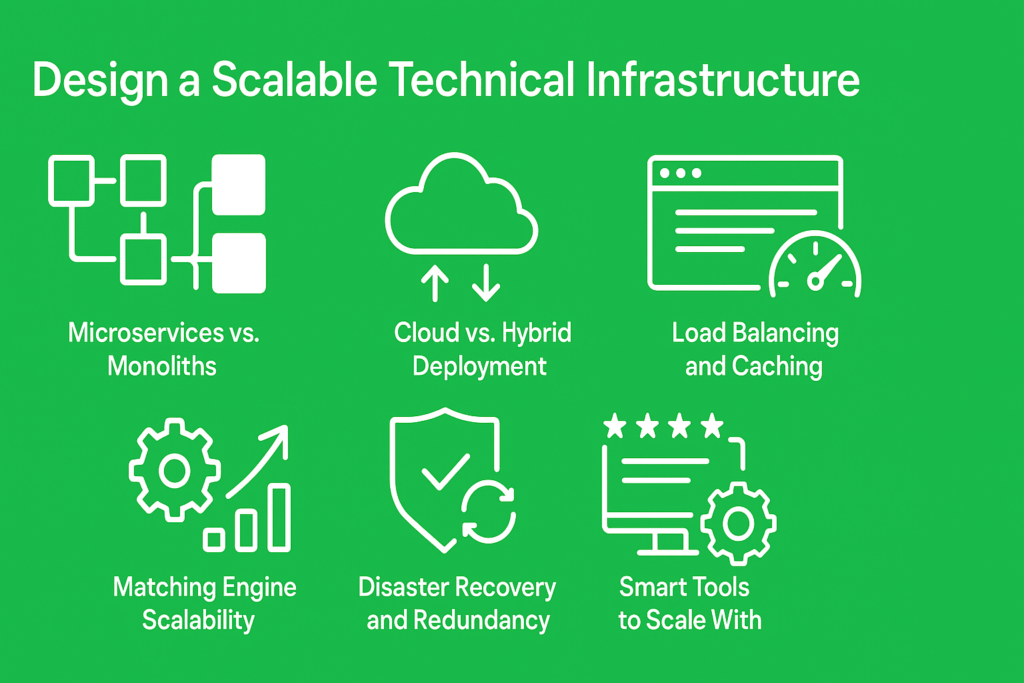
Microservices vs. Monoliths
Start with your architecture. Monoliths are easier to build early on, but hard to scale. Every update touches the whole system, which slows you down.
Microservices break the exchange into smaller parts (like login, trading, and wallets), so you can update and scale each piece without touching the others. It’s faster, safer, and more flexible.
Cloud vs. Hybrid Deployment
Hosting matters. Running everything on physical servers limits how fast you can grow. Cloud platforms like AWS or Google Cloud let you spin up new resources fast when traffic spikes.
Hybrid models give you more control – keep critical systems in-house, run everything else in the cloud.
Load Balancing and Caching
Speed is everything in trading. Load balancers help spread traffic so no server gets overloaded. Caching tools like Redis cut response times by storing frequently used data like order books or user info in memory.
Matching Engine Scalability
Your matching engine does the heavy lifting. It must process thousands of trades per second – accurately and instantly. Invest in multithreading, low-latency networking, and smart queuing. The faster your engine, the more volume you can handle without breaking.
Disaster Recovery and Redundancy
Things break. Be ready. If one data center goes down, your platform must stay live. Use geo-redundancy, run backups in different regions. Add real-time monitoring with tools like Prometheus and dashboards via Grafana to spot issues before users do.
Smart Tools to Scale With
When traffic spikes or something breaks, the right tools can save your platform and your reputation. Here are a few must-haves:
- AWS Auto Scaling: This tool automatically adds or removes servers based on how much traffic you’re getting. No need to guess capacity or overpay for unused resources. When trading volume surges, your platform stays fast.
- Redis: Redis stores frequently used data (like prices, order books, or user sessions) in memory instead of pulling it from your database each time. That means faster page loads and better performance, especially during peak hours.
- Prometheus + Grafana: These tools work together to monitor your system. Prometheus collects real-time data (like CPU usage or server errors), and Grafana turns that data into simple, readable dashboards. You’ll know when something’s off—before your users do.
Expand Liquidity Without High Spend
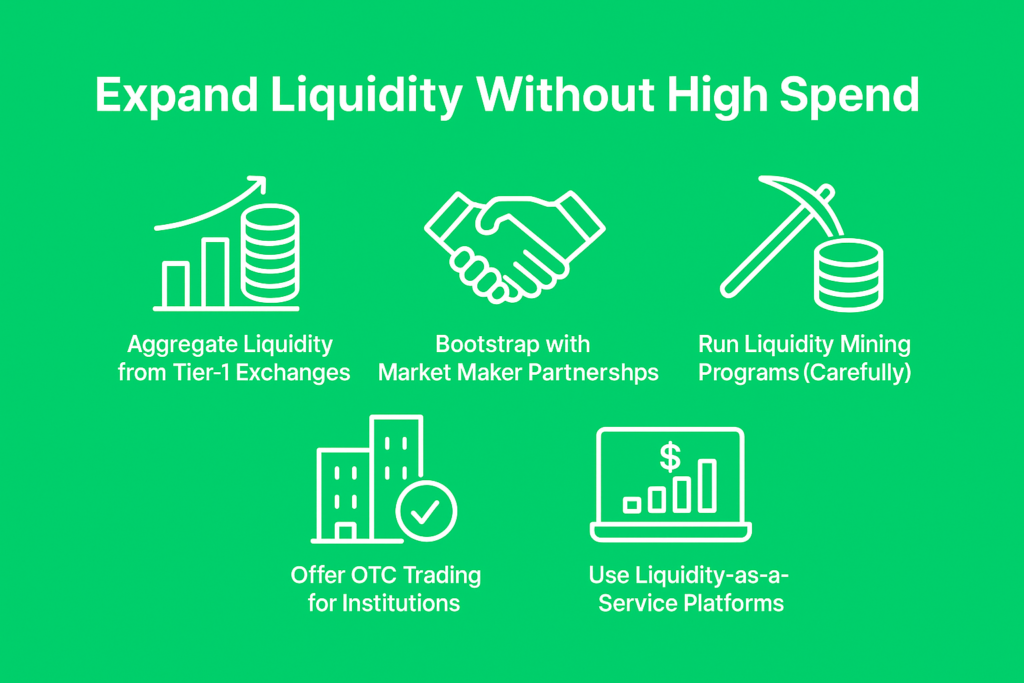
You don’t need millions to build deep liquidity, but you do need a smart strategy. Without enough liquidity, traders face slippage, wide spreads, and poor execution. Here’s how to fix that without draining your budget:
- Aggregate Liquidity from Tier-1 Exchanges: Connect to top exchanges using APIs. By routing orders through their books, you can instantly show tight spreads and higher depth, without building it all from scratch.
- Bootstrap with Market Maker Partnerships: Partner with market makers who bring volume to your platform. In return, offer them incentives like fee discounts or token deals. Choose trusted firms that maintain tight spreads and support multiple trading pairs.
- Run Liquidity Mining Programs (Carefully): You can attract liquidity by rewarding users with tokens for trading or staking. Just be cautious – if not managed well, these programs lead to wash trading and inflated metrics. Always tie rewards to real volume and clear metrics.
- Offer OTC Trading for Institutions: Some clients want to trade big, but without moving the market. OTC (over-the-counter) desks let them do just that. This reduces slippage, brings in higher-value traders, and builds long-term volume off-book.
- Use Liquidity-as-a-Service Platforms: Platforms like B2BX or Finery Markets offer plug-and-play liquidity across dozens of assets. These services connect you to aggregated order books and professional traders, cutting both setup time and cost.
Add High-Impact Features Users Actually Want
You don’t need to build everything – just what users actually use. Focus on features that increase engagement, boost retention, and drive trading activity. Here’s where to start:
- Support Spot, Margin, and Derivatives Trading: Most exchanges begin with spot trading. To grow, you’ll need to offer margin (trading with leverage) and eventually derivatives (like perpetual contracts or futures). These attract more advanced users and increase trading volume.
- Add Staking and Earn Options: Not all users are active traders. Some just want to earn on their crypto while holding. Offer staking for PoS coins and simple earn products with clear rewards and terms. It keeps users on your platform and builds trust. New users often look for simple guides on how to stake crypto, so offering clear staking options helps retention.
- Launch a Referral Program and Rewards: Let your users become your marketers. Reward them for inviting friends, completing trades, or joining events. Gamify it with points, badges, or fee discounts—small perks go a long way in driving daily engagement.
- Offer Token Launchpads or IEOs: Let users participate in early-stage crypto projects right from your exchange. A trusted launchpad builds buzz, brings in new users, and creates additional revenue through listing fees or token sales.
- Use Feature Data to Cut What’s Not Working: Monitor which features your users actually use. If nobody touches your trading academy or NFT section, don’t keep pouring resources into it. Use usage data to phase out weak tools and double down on what users love.
Optimize UX Without Building from Scratch
You don’t need to reinvent your platform to deliver a better user experience. Small, smart upgrades can make a big difference, especially for new users and mobile-first traders.
- Keep the UI Clean and Easy for All Traders: Whether someone’s just starting out or managing complex trades, your interface should be fast, clear, and clutter-free. Simple navigation, clear charts, and easy order types go a long way in building user confidence.
- Optimize the Mobile App Experience: Most users will access your exchange from their phones. Make sure the app is responsive, loads fast, and syncs in real time with the web version. A buggy app can cost you serious volume.
- Use Self-Service Onboarding & Progressive KYC: Don’t overwhelm new users with paperwork. Let them start with basic features and unlock more as they complete KYC steps. This keeps the funnel wide while staying compliant.
- Speed Up Development with UI Kits or Open Source Libraries: Save time and money by using battle-tested white-label UI kits or open-source components. You’ll get a polished, responsive UI without the cost of building everything from scratch.
- Use Heatmaps and Behavior Analytics to Spot Issues: Track how users move through your platform—where they click, where they drop off. Heatmaps and tools like Hotjar or FullStory show what’s working and what’s confusing, so you can fix it fast.
Build a Lean, Multi-Channel Marketing Engine
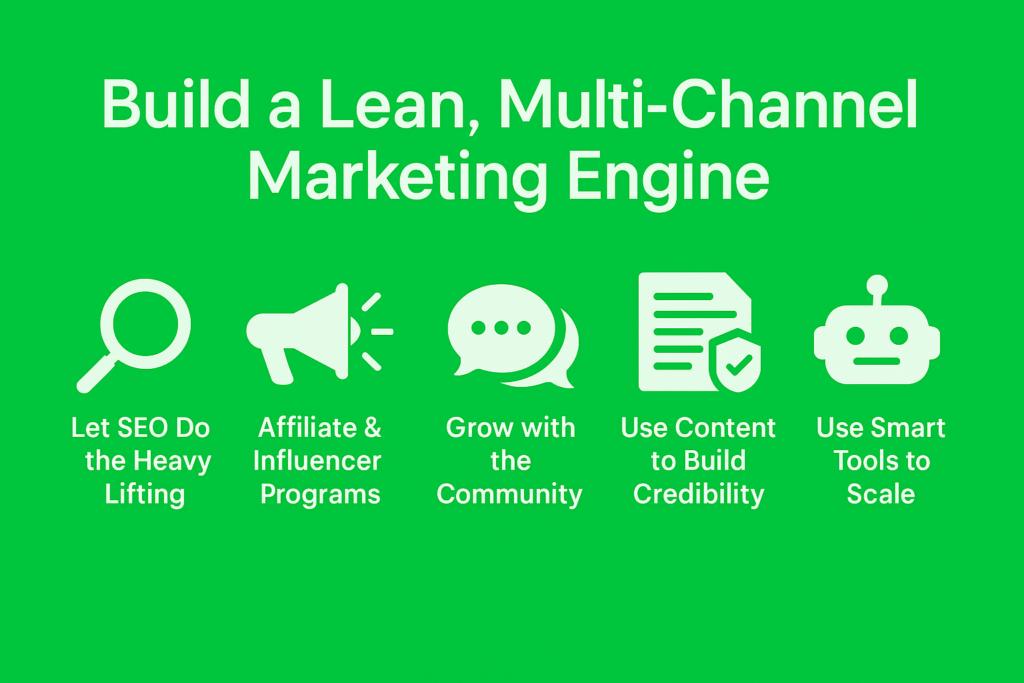
You don’t need a massive ad budget to grow your exchange—you need the right message in the right places. Here’s how to get traction without burning through cash:
- Let SEO Do the Heavy Lifting: Focus on content that brings users in through search. Write guides, token listings, and market insights that rank for keywords traders are Googling. Avoid fluff. Think: “how to buy Bitcoin”, “best crypto exchange for trading”, “fees comparison”. These bring in traffic that converts – without ad spend.
- Launch Affiliate & Influencer Programs: Give creators and crypto influencers a reason to talk about you. Share revenue, give them tracking links, and offer bonuses for driving active users. Affiliates are one of the cheapest and most effective ways to scale. Explore proven crypto affiliate strategies to grow faster without large ad budgets.
- Grow with the Community, Not Just at Them: Crypto lives on Reddit, X (Twitter), and Discord. Be active. Host AMAs, post updates, reply to criticism, and build trust with real users. Community-led growth scales better than one-time ad campaigns.
- Use Content to Build Credibility: Publish how-to guides, security updates, market reports, and proof-of-reserve breakdowns. Transparency builds trust. Traders want to know you’re stable and legit before they move funds.
- Use Smart Tools to Scale Content Creation: Platforms like ChatGPT + SurferSEO or Frase can help generate SEO-ready outlines and drafts faster. But don’t just hit publish – review and humanize everything before it goes live.
Stay Compliant While Expanding
As you grow into new markets, regulations will follow you. You need to understand which jurisdictions are crypto-friendly and start there. Countries like Lithuania, UAE, and Singapore often offer clear frameworks and faster licensing paths. It’s easier (and cheaper) to go live in regions that support digital asset businesses from the start.
But launching legally isn’t enough. You also need to stay ahead of global standards like the FATF’s Travel Rule. That means building systems that can securely share originator and beneficiary information when users send crypto across platforms. If you’re not ready, expect delays, fines, or even delisting in key regions.
Thankfully, you don’t have to build a full compliance team in-house from day one. Many exchanges now rely on Compliance-as-a-Service providers like Sumsub, Chainalysis, or Notabene to handle KYC, AML, risk scoring, and transaction monitoring. These tools are fast to deploy, customizable, and updated regularly to meet changing laws – saving you time and reducing exposure.
Finally, test before you scale. Sandbox your new features. This way, you reduce regulatory risk and collect early feedback without jeopardizing your core business. Expansion should always be intentional, not reactive. Compliance done right protects your users, your brand, and your ability to grow globally.
Automate to Save Costs and Prevent Bottlenecks
Automation is your best weapon against rising overhead and slow workflows. Here’s how to build smarter systems that grow with you:
- Automate KYC/AML checks: Use tools that scan IDs, match faces, and flag risky users in real-time. This shortens onboarding and keeps you compliant without hiring a massive team.
- Detect fraud through user behavior: Set up systems that monitor trading habits, login patterns, and withdrawal activity. Spot unusual moves and block suspicious accounts before damage is done.
- Use smart order routing: Automatically scan other exchanges and liquidity pools to fill orders at the best possible price. It keeps your users happy and reduces slippage risk.
- Deploy bots for community support: Chatbots can answer common questions, send users to the right help docs, and flag issues to real agents only when needed. Saves your support team from drowning.
- Build internal dashboards for real-time tracking: With tools like Notion, Zapier, or Airtable, you can monitor KYC queues, ticket volume, liquidity snapshots, and more, without custom software builds.
Strategic Growth Through Partnerships
You don’t have to build everything in-house. Smart partnerships can unlock faster growth, improve user experience, and keep your platform lean. Here’s where to focus:
Plug in Trusted Payment Gateways and Fiat On-Ramps
Making it easy for users to deposit local currency is one of the fastest ways to boost activity. Instead of building your own payment stack, partner with regulated fiat on-ramp providers. Stripe, MoonPay, or Mercuryo can handle bank cards, Apple Pay, and local transfer options, without the compliance burden falling on you.
Use DeFi Protocols to Tap Extra Liquidity
You can expand liquidity without hiring a market-making team. By integrating with DeFi protocols or aggregators, your exchange can access token pools across chains. This approach brings more volume and tighter spreads, especially for trending altcoins or stablecoin pairs.
Partner with Institutional Custody and OTC Desks
Institutional traders expect bank-grade custody and large order handling. Instead of building that infrastructure yourself, team up with established custodians (like Fireblocks or BitGo) and OTC desks. This builds trust and opens doors to big-ticket clients who won’t touch retail-grade solutions.
Add Tax Reporting and Portfolio Tools
Retail traders need help staying tax-compliant and tracking profits. You can improve retention and reduce support queries by offering plug-and-play integrations with tools like Koinly or CoinTracking. These platforms let users export reports, track portfolio performance, and even file crypto taxes—all while staying on your exchange.
Risk Management Table
| Risk Area | What to Do (Short Tip) |
| Stress Testing | Simulate 10x trading volume to test performance limits. |
| Cold Wallet Management | Keep most funds offline; set smart withdrawal limits. |
| Security Audits | Run regular penetration tests and red teaming exercises. |
| Insurance & SAFU | Create an insurance reserve fund to protect users. |
| Crisis Playbooks | Document clear action plans for outages or bad press. |
Monitor Metrics
Scaling blindly is dangerous. You need to measure what matters. Tracking the right metrics helps you know if you’re growing in the right direction or just burning resources.
Daily Active Traders vs. Total Signups
Don’t just look at how many people signed up but check how many are actually trading. A high signup count with low activity means something’s broken in your onboarding or user experience. You’re not scaling if people don’t stick around.
Churn Rate and Lifetime Value (LTV)
Are users staying, or are they disappearing after a few trades? Churn tells you how fast you’re losing users. LTV shows how much each one brings in over time. You want high LTV and low churn.
Cost per Liquidity
How much does it cost you to maintain deep enough order books for smooth trading? If liquidity is expensive, find smarter ways to source it – like partnerships or Liquidity-as-a-Service providers. Don’t overspend just to fake depth.
Order Book Depth per Pair
Raw volume doesn’t tell the full story. Are your trading pairs actually usable? Shallow books lead to slippage and angry traders. Track how deep your order book is – especially on your most popular assets. It affects real-world trading quality.
Score Your Exchange’s Scale Readiness
Create your own quarterly “scale-readiness” checklist. Score your platform on performance, compliance, liquidity, user retention, and security. This keeps your growth plans grounded in reality, not just wishful thinking.
Conclusion
You don’t need a giant war chest to grow your crypto exchange — you just need a smarter plan. The most successful platforms aren’t always the ones with the biggest budgets. They’re the ones that invest in the right infrastructure, build trust with users, and stay ahead of regulations.
If you want to scale a crypto exchange the right way, focus on what actually moves the needle: fast performance, strong liquidity, real security, and meaningful features your users care about. Don’t chase trends. Don’t overspend. Scale with purpose and based on real numbers.
FAQs
What’s the cheapest way to improve liquidity?
One of the most cost-effective ways to improve liquidity is by integrating with Liquidity-as-a-Service providers or aggregating liquidity from top-tier exchanges. You can also work with market makers or launch a basic referral-based liquidity mining program but always monitor for abuse.
What trading features should I prioritize when scaling?
Focus on core features that drive the most engagement: spot trading, margin trading, staking for passive income, and referral programs. These are proven to attract both new and experienced users. Add complex features (like derivatives or launchpads) only when you have solid demand and compliance in place.
How do I prepare my platform for institutional clients?
Institutions look for stability, regulation, and deep liquidity. To attract them, secure custody options, fast execution, KYC/AML compliance, and OTC support are essential. You’ll also need clean APIs and strong customer support. Consider partnering with institutional-grade service providers.
How much capital reserve is ideal before scaling?
There’s no universal number, but many exchanges aim to have at least 12–18 months of operating runway in reserve. This includes covering server costs, staff, legal fees, and liquidity needs. Having a reserve also allows you to survive volatility or regulatory delays without halting growth plans.
Can I scale without listing hundreds of coins?
Yes. In fact, listing too many low-quality tokens can damage your reputation. Focus on high-volume, in-demand assets that have real liquidity and user interest. It’s better to offer 20 strong pairs than 200 that barely trade. Quality attracts better traders and keeps compliance risks lower.